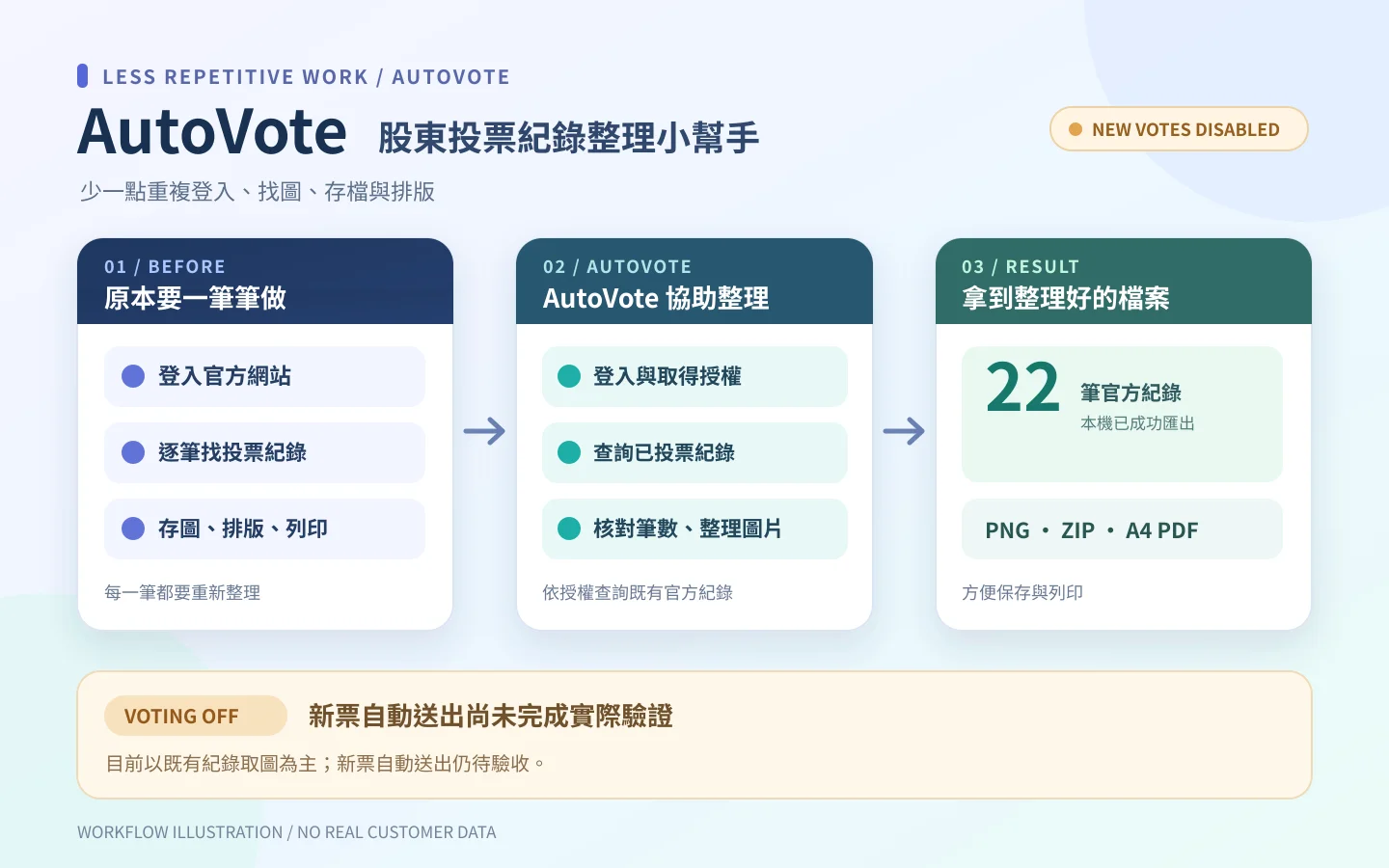
With the account holder's authorization, the tool looks up meetings that already have voting records instead of requiring repeated manual navigation.
Why I built it
I wanted to make a small but repetitive part of the work easier.
When handling shareholder-gift paperwork, there are situations where electronic voting records need to be checked or prepared for printing. Doing this manually means signing into the official site, finding each company and meeting, saving the receipt, and arranging the files. With multiple records, even these simple steps add up, and it's easy to miss entries on another page.
That's why I started building AutoVote. The goal isn't to decide how anyone should vote. It's to handle the repetitive looking-up, organizing and exporting that software can do more consistently.
How it helps
Turn scattered steps into a more manageable workflow.
It organizes existing receipts by company and meeting and checks record counts across pages to avoid missing or duplicated entries.
Receipts can be saved individually, bundled in a ZIP or prepared as an A4 PDF for batch printing.
Users sign in and give permission first. Certificates and stored receipts are encrypted, and access is restricted to the relevant account.
What using it should feel like
From giving permission to getting organized files.
Sign in and authorizeGoogle sign-in and the user's certificate
Find existing recordslook up official results with authorization
Organize and checkconfirm counts and group the receipts
Download or printindividual images, ZIP or A4 PDF
This is the complete experience I'm building toward. Public Google sign-in and local receipt retrieval have been verified separately, but the full certificate-upload-to-receipt journey on the public site has not yet passed an end-to-end test.
Where it stands today
22 existing receipts retrieved locally. Unverified features are still labeled as such.
On 2026-11-22, I used an authorized account locally to retrieve 22 existing official voting receipts from two pages, checked the record counts and prepared images and print files. Real Google sign-in has also been tested on the public portal. The full public upload, lookup and download flow still needs live validation.
New-ballot submission remains disabled. Automated abstention voting has been implemented and tested with simulated scenarios, but it has not been validated with an eligible live ballot. I can't claim the system has successfully submitted a new real-world vote.
What mattered to me while building it
Voting records and digital certificates aren't things to handle casually. Users must authenticate and authorize access. Google login and Windows DPAPI encryption protect account and locally stored sensitive data.
If an official page changes, records don't match, or a voting result is uncertain, the program should stop rather than guess or resubmit.
Workflow illustration